X-ray fluorescence (XRF)
X-ray fluorescence (XRF)
X-ray fluorescence (XRF) is a non-destructive analytical technique for determining the elemental composition of materials. By measuring the characteristic fluorescent X-rays emitted by a sample under primary X-ray excitation, the technique provides information about the elements present and their relative or absolute concentrations.
Our laboratory provides XRF analysis of bulk materials, coatings and thin-film structures. Depending on the sample and measurement configuration, the technique supports qualitative and quantitative elemental analysis, coating composition determination and investigation of elemental variations.
Our XRF services combine precise measurements with advanced data processing and expert interpretation, delivering reliable information about the elemental composition of your samples for research, material characterization and quality control.
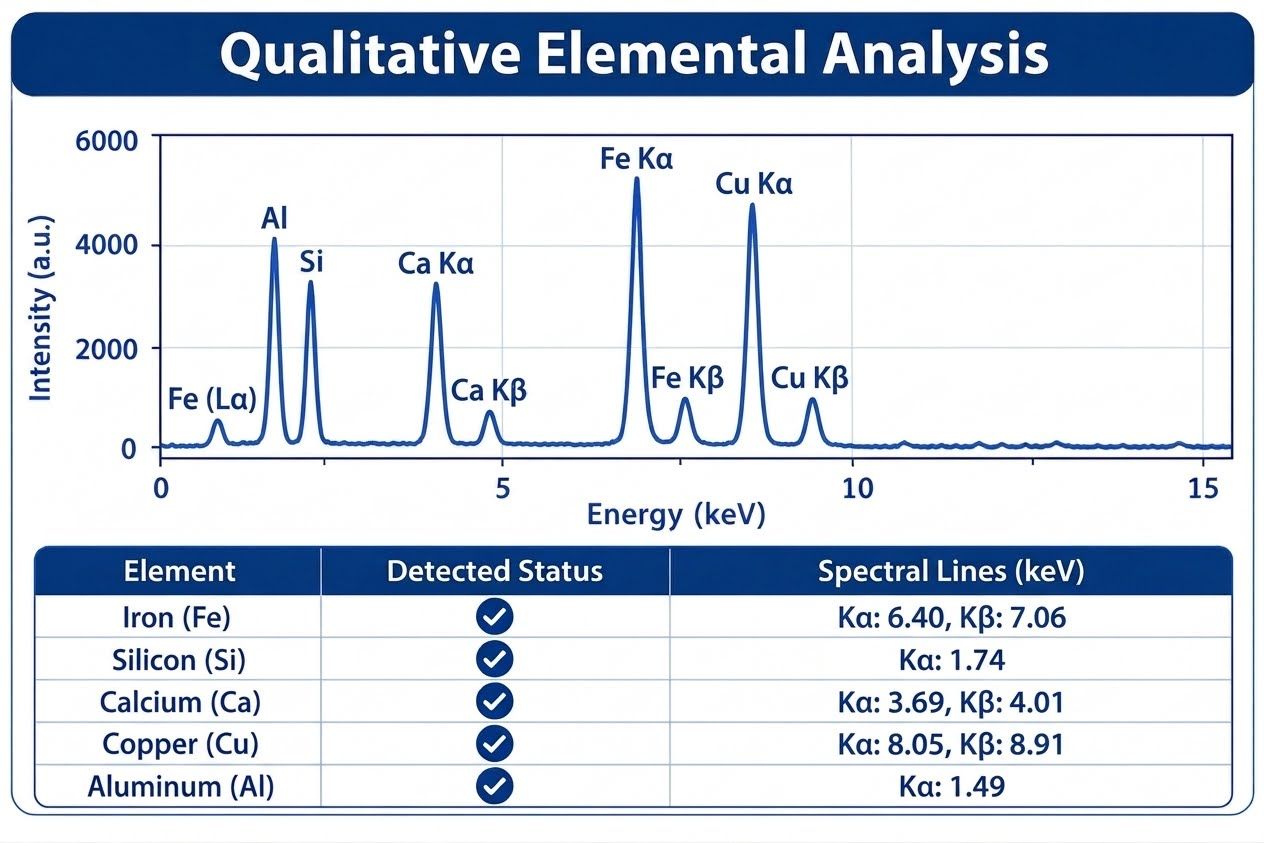
Qualitative Elemental Analysis
We provide qualitative X-ray fluorescence (XRF) analysis to identify the chemical elements present in a sample. By examining the characteristic energies of fluorescent X-rays emitted under X-ray excitation, we identify the elements contributing to the measured spectrum.
This technique provides a rapid overview of the elemental composition of powders, bulk materials, metals, alloys, ceramics and coatings. It is particularly useful for preliminary material characterization, verification of material composition and identification of unknown or unexpected elements.
Key Results Delivered
Elemental Identification: Identification of the elements detected in the measured XRF spectrum.
XRF Spectrum: A graphical representation of the measured fluorescence spectrum, showing characteristic peaks associated with the detected elements.
Peak Assignment: Identification and labeling of characteristic fluorescence lines corresponding to individual elements.
Elemental Overview: A summary of the detected elements, distinguishing major spectral contributions from weaker signals where possible.
Measurement Documentation: Information about measurement conditions, excitation parameters, analyzed area and instrumental configuration.
Data Interpretation: Expert evaluation of the spectrum, including discussion of detected elements and analytical limitations.
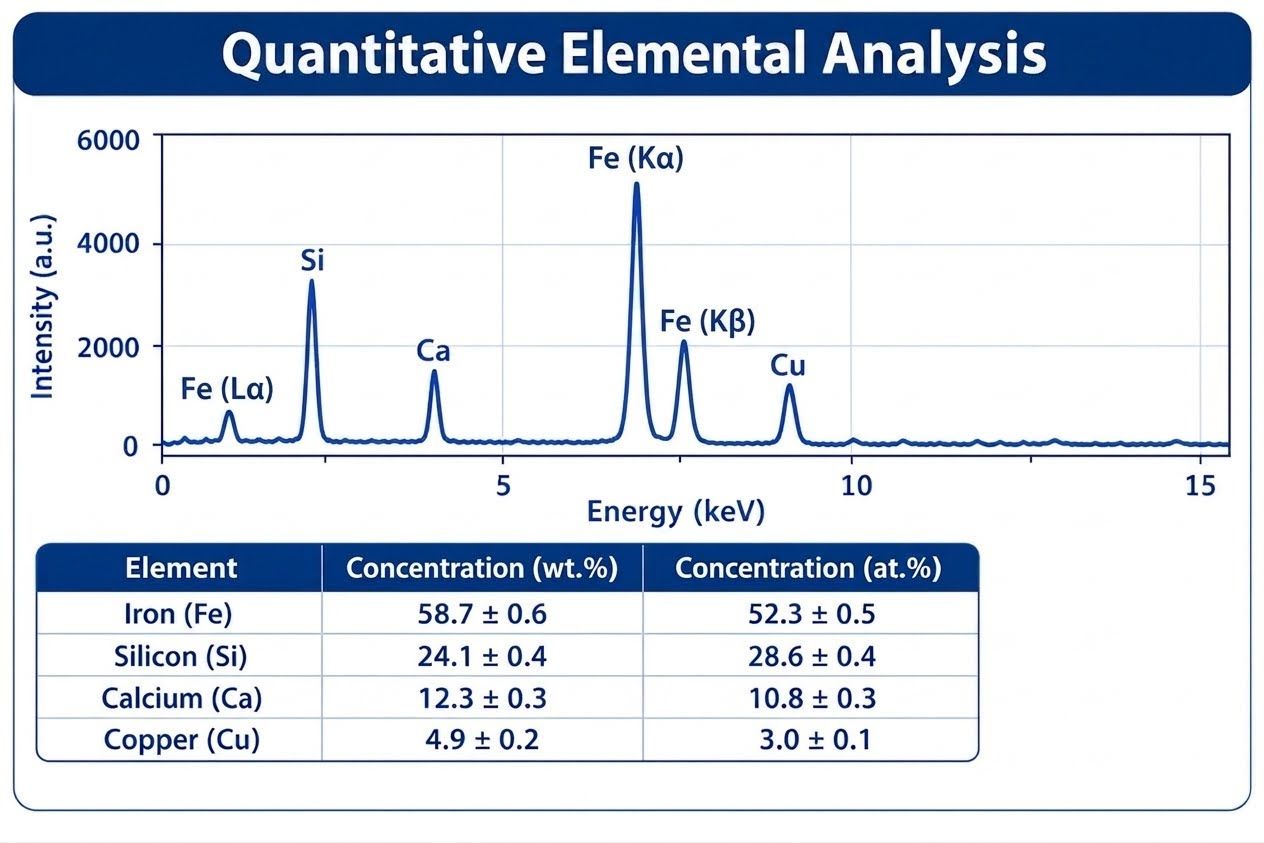
Quantitative Elemental Analysis
We provide quantitative X-ray fluorescence (XRF) analysis to determine the concentrations of individual elements in a sample. By evaluating the intensities of characteristic fluorescent X-ray lines and applying appropriate calibration procedures or fundamental-parameter calculations, we estimate the elemental composition of the analyzed material.
Our quantitative XRF capabilities are suitable for a wide range of materials, including powders, bulk samples, metals, alloys and inorganic materials. Depending on the sample properties and analytical method, results can be expressed as weight percentages (wt.%) or atomic percentages (at.%).
Key Results Delivered
Quantitative Elemental Composition: Determination of the concentrations of detected elements, expressed in wt.% or at.%, where supported by the analytical method.
Elemental Composition Table: A structured table summarizing the calculated concentrations of individual elements.
XRF Spectrum: Measured fluorescence spectrum with characteristic peaks assigned to the corresponding elements.
Concentration Assessment: Evaluation of major and minor elemental constituents and their relative contributions to the overall composition.
Measurement Documentation: Information about measurement conditions, calibration approach, excitation parameters and relevant instrumental settings.
Data Interpretation: Expert evaluation of the quantitative results, including consideration of matrix effects, spectral overlaps and other factors affecting analytical accuracy.
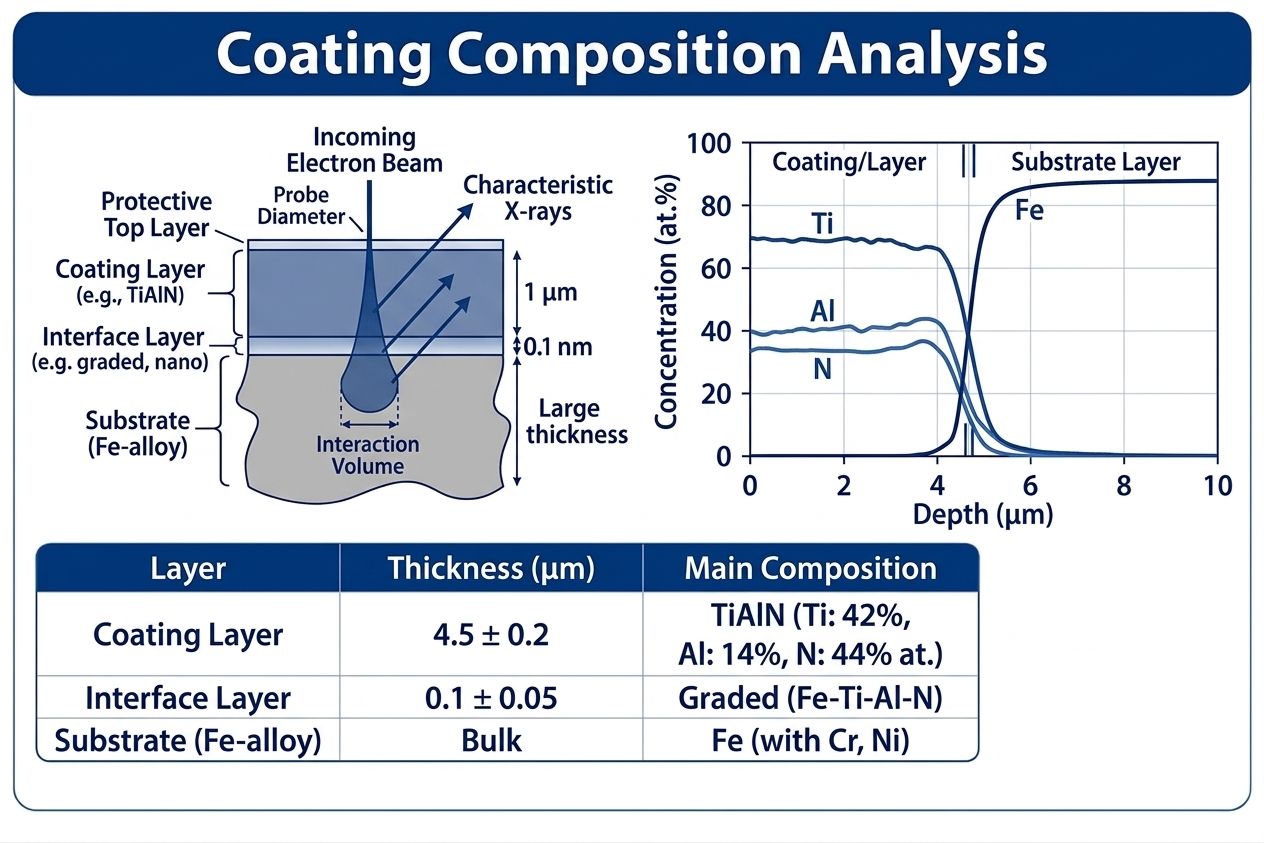
Coating Composition Analysis
We provide XRF analysis of metallic and inorganic coatings to determine their elemental composition and evaluate the relative content of their constituent elements. By measuring the characteristic fluorescent X-rays emitted from the coating, we can identify its main components and assess variations in composition.
Our XRF systems support the investigation of a wide range of coating materials, including single-layer and multicomponent metallic coatings deposited on different substrates. The analysis can be performed on selected areas of the sample, allowing local characterization without the need for destructive sample preparation.
Key Results Delivered
Elemental Identification: Identification of the elements present in the analyzed coating, with consideration of possible contributions from the substrate.
Coating Composition: Quantitative determination or estimation of the elemental content, expressed in weight percent (wt.%) or atomic percent (at.%), depending on the analytical method.
XRF Spectrum: Measured fluorescence spectrum showing the characteristic peaks of the coating elements and relevant substrate signals.
Local Composition Analysis: Elemental composition measured at selected positions, allowing comparison between different areas of the coating.
Measurement Documentation: Information about the analyzed area, excitation conditions, measurement parameters and instrumental configuration.
Data Interpretation: Evaluation of the measured composition, including possible substrate contributions, spectral overlaps and analytical limitations.
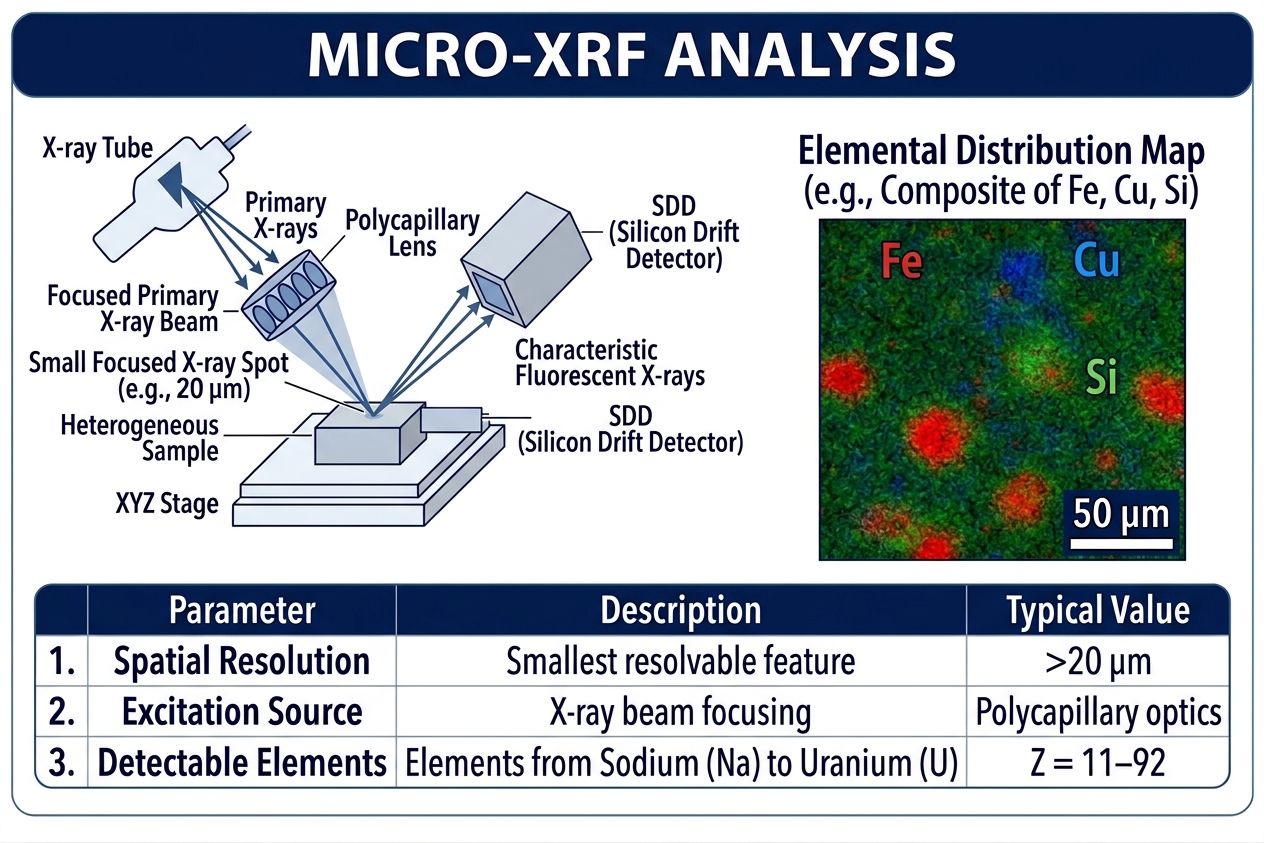
Micro-XRF Analysis
We provide high-resolution micro-XRF analysis using our Bruker ARTAX system to investigate the elemental composition of small, selected areas on a sample surface. By focusing the X-ray beam to a micrometre-scale spot, the technique enables localized elemental analysis while preserving the sample.
Micro-XRF is particularly useful for heterogeneous materials, coatings, small components and samples with locally varying composition. It allows us to examine specific features and compare the elemental composition of different regions without requiring extensive sample preparation.
Key Results Delivered
Localized Elemental Identification: Identification of the elements present within the selected measurement area.
Quantitative Composition: Determination or estimation of elemental concentrations, expressed in wt.% or at.%, where supported by the sample and calibration method.
Micro-XRF Spectrum: A detailed fluorescence spectrum showing the characteristic peaks of the detected elements.
Point-by-Point Comparison: Elemental composition measurements at multiple selected positions, enabling comparison of local variations.
Small-Area Characterization: Analysis of specific features, inclusions, coating regions or other areas of interest that may not be representative of the overall sample.
Measurement Documentation: Information about the analyzed positions, beam conditions, acquisition parameters and instrumental configuration.
Data Interpretation: Expert evaluation of the results, including identification of local compositional differences and possible spectral interferences.
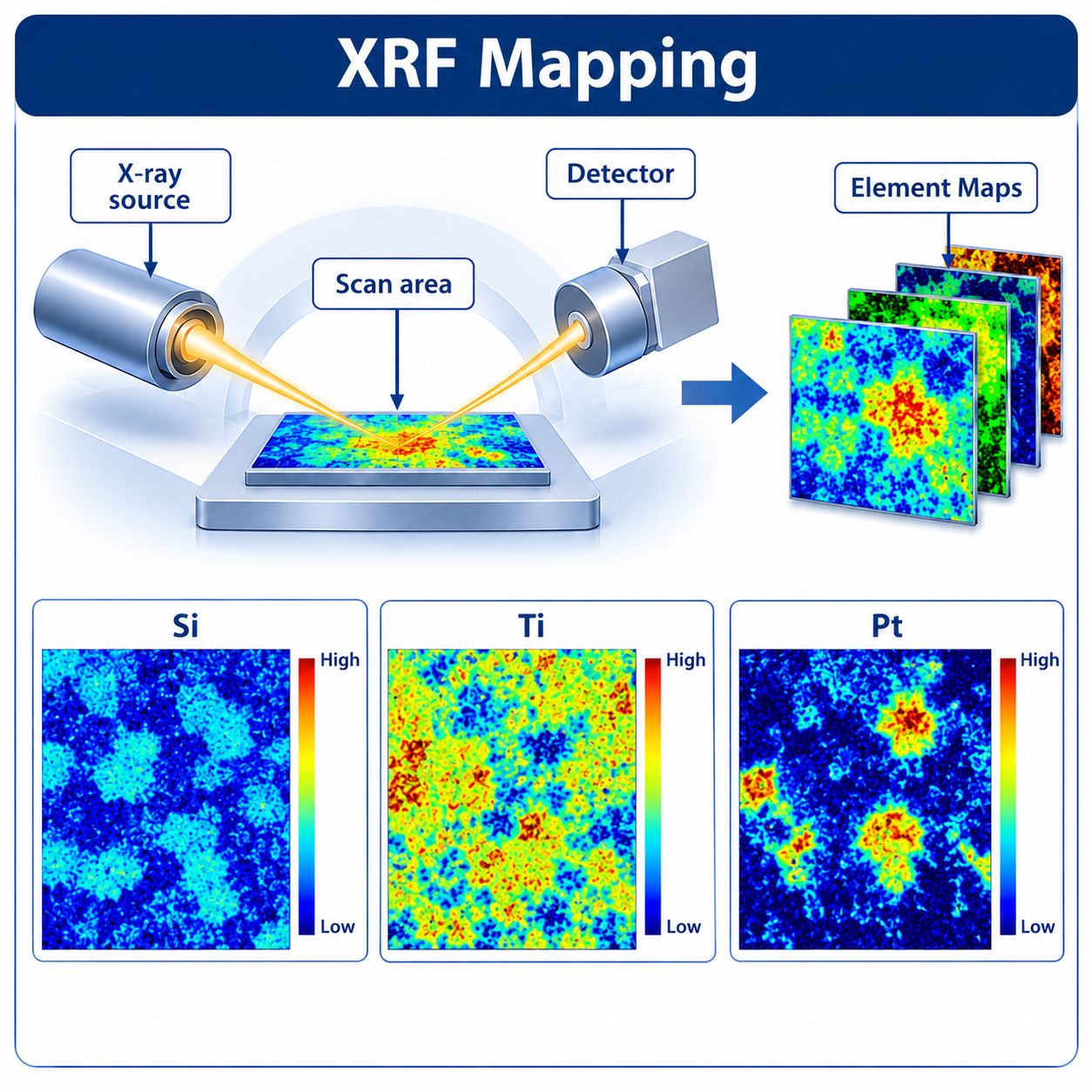
Elemental Distribution & Surface Inhomogeneity Analysis
We provide XRF mapping and localized surface analysis to investigate the spatial distribution of chemical elements and identify compositional variations across a sample. By scanning selected surface areas and collecting fluorescence spectra at successive measurement positions, we generate detailed elemental maps that reveal the distribution of individual elements.
This approach is particularly useful for heterogeneous materials, coatings, ceramics, metallic surfaces and other samples where the elemental composition may vary locally. It enables the identification of inclusions, segregated regions, surface contamination and areas with increased or decreased concentrations of specific elements.
Key Results Delivered
Elemental Distribution Maps: Two-dimensional maps showing the spatial distribution of selected elements across the analyzed area.
Individual Element Maps: Separate visualizations for each detected element, allowing detailed investigation of its distribution.
Composite Element Maps: Combined visualizations of multiple elements to reveal spatial relationships and compositional patterns.
Surface Inhomogeneity Identification: Detection of local compositional variations, inclusions, segregated regions and areas with abnormal elemental signals.
Surface Contamination Detection: Identification of localized regions containing elements that may indicate surface contamination or foreign material.
Elemental Intensity Data: Numerical data representing the measured XRF signal intensity at each scanning position.
Data Interpretation: Expert evaluation of elemental distribution patterns and their possible relationship to material composition, processing or surface condition.
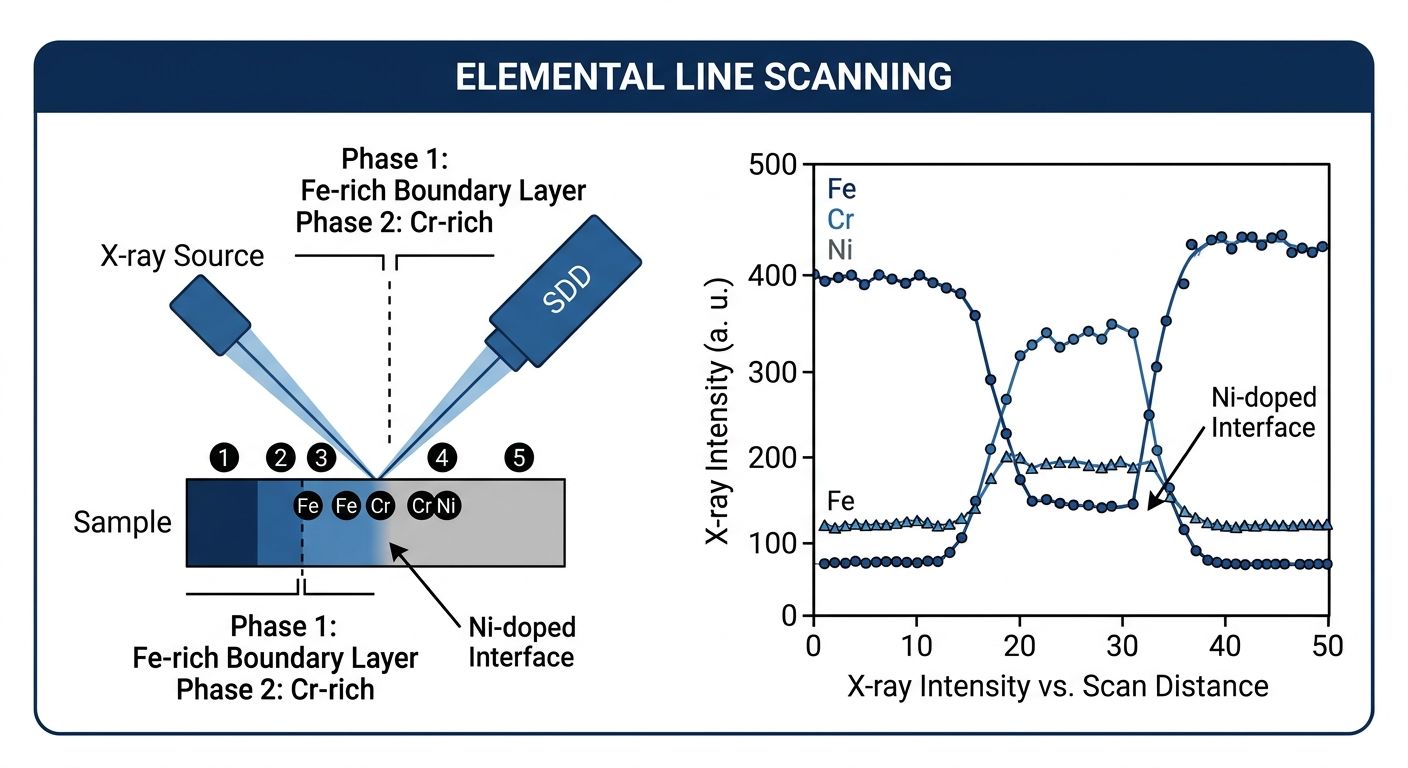
Elemental Line Scanning
We provide XRF line scanning to investigate changes in elemental composition along a selected path across a sample surface. During the measurement, the X-ray beam moves along a predefined line while fluorescence spectra are continuously acquired at successive positions.
This technique provides a detailed profile of elemental distribution along the selected direction, making it particularly useful for investigating coating interfaces, material transitions, diffusion zones, compositional gradients and localized contamination.
Key Results Delivered
Elemental Intensity Profiles: Graphs showing the variation of characteristic XRF signal intensity for selected elements along the scanned line.
Elemental Distribution Profiles: Spatial profiles illustrating changes in the relative distribution of individual elements across the analyzed region.
Interface Characterization: Identification of compositional transitions between different materials, layers or surface regions.
Elemental Gradient Analysis: Evaluation of gradual changes in elemental distribution, including enrichment or depletion zones.
Comparative Analysis: Comparison of elemental profiles measured along different positions or directions on the same sample.
Measurement Data: Numerical data containing the scanning coordinates and corresponding XRF intensities for detected elements.
Data Interpretation: Expert evaluation of elemental profiles, including identification of compositional transitions and localized variations.